
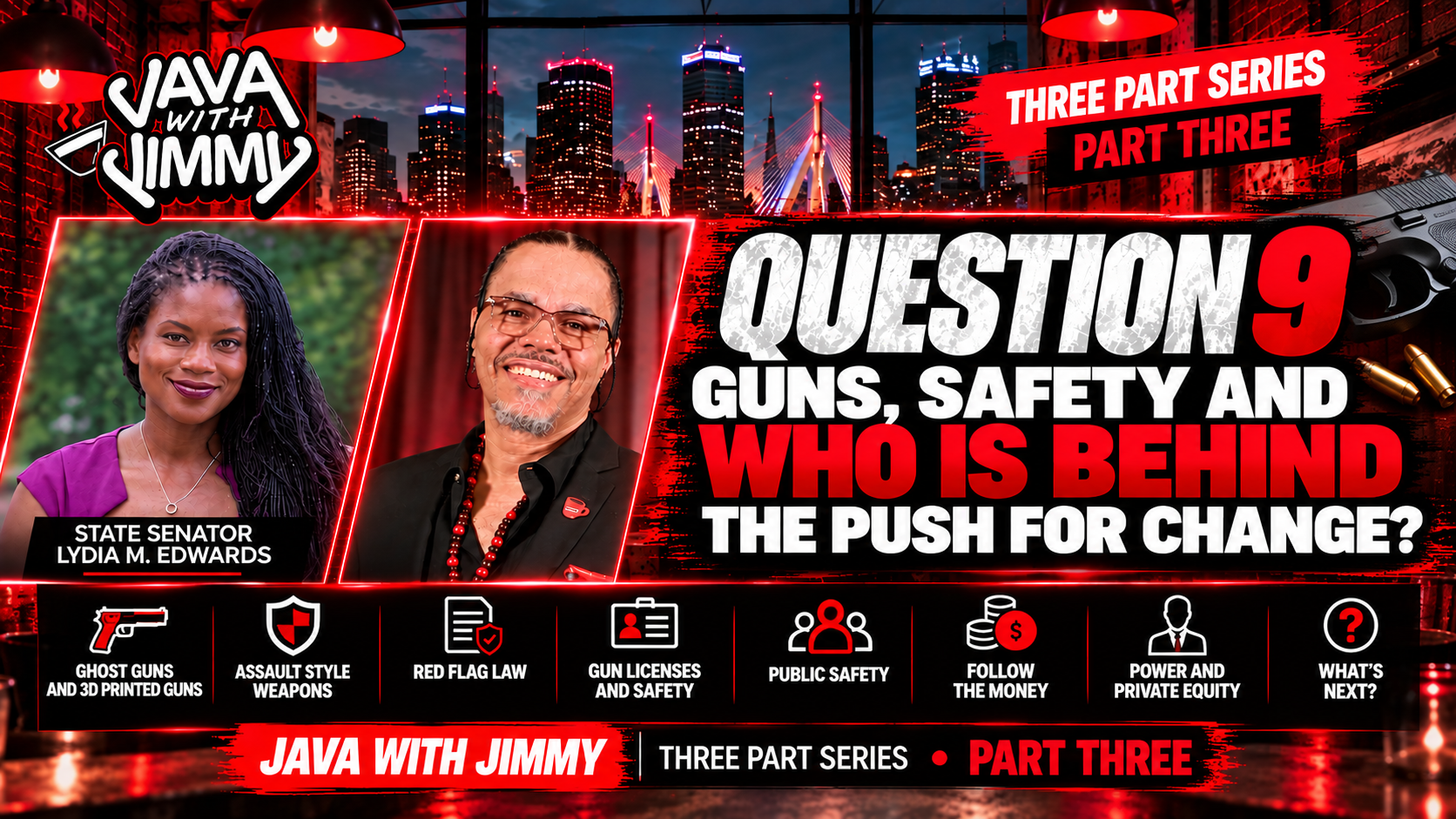
QUESTION 9: Guns, Safety, and Who Is Behind the Push for Change?
By James “Jimmy” Hills
WATCH THE ENTIRE CONVERSATION HERE
This is the third and final part of my conversation with State Senator Lydia Edwards about three Massachusetts ballot questions that stood out to me: Questions 3, 8, and 9.
Question 3 is about how we vote. Question 8 is about legal recreational marijuana. Question 9 is about guns.
Three very different issues.
But by the end of our conversation, I kept coming back to the same question:
Who is behind the push for change, who has the money, and who could be most impacted?
First, what is Question 9?
Question 9 deals with the gun law Massachusetts passed in 2024.
A Yes vote keeps that law in place. A No vote repeals it.
The law covers a lot. It regulates ghost guns and 3D-printed guns. It deals with assault style weapons and devices that can make some guns fire like machine guns. It also expands the state’s red flag law and creates more rules around gun licenses, safety, and data.
Edwards was in the Senate when the law was being worked on and passed.
She told me lawmakers were trying to keep up with technology.
“We felt, and I still feel, we were meeting the moment.”
That includes guns that can be made with 3D printers and guns without serial numbers that can be hard for law enforcement to trace.
But there is another side.
Edwards also explained the concern from people who oppose the law.
She said many are gun owners who believe the government has gone too far and made it harder for them to exercise their constitutional rights.
That debate matters.
This is about public safety, but it is also about constitutional rights and how far government should go when regulating guns.
Edwards believes Massachusetts got the balance right.
“I say we’re doing the right thing.”
Then I noticed something.
As we wrapped up Questions 3, 8, and 9, I told the Senator something had been sitting with me.
These are three very different ballot questions, but I kept looking at power and money.
On Question 3, Edwards pointed directly to wealthy donors and private equity executives. She said about $4 million of roughly $5 million raised at that point had come from around 15 people. She described the effort as coming from the top, not from communities like Roxbury, Dorchester and Mattapan. That was her argument, and it is important to name it as such.
During our conversation, I put my own observation a little more plainly:
“They’re much, much lighter than me and have a lot more money.”
That does not mean every person supporting or opposing these questions is a rich white man. The transcript itself names Black leaders and elected officials who support Question 3.
But the money question is still worth asking.
Follow the money, but also follow the impact.
That may be my biggest takeaway from this whole series.
Question 3 asks us to think about political power and who gets through the door.
Question 8 asks us to think about Black economic development, criminal justice, and whether we have finished repairing the harm caused by the War on Drugs.
Question 9 asks us to think about gun rights, new technology, and public safety.
The questions are different. The people supporting and opposing them are not all the same.
But there is a common thread worth paying attention to:
Who has power? Who has money? Who helped write or fund the change? Who benefits? And who could lose something if it passes?
That does not tell us how to vote.
But it tells us what questions we should be asking before we do.
Because nine questions are on the Massachusetts ballot this year, and some of them could make major changes to state law.
Read them. Understand what Yes actually does. Understand what No actually does.
And as Senator Edwards kept bringing us back to throughout our conversation, look beyond the words on the ballot and ask:
Who benefits?
This is Part Three and the final article in my Java With Jimmy series examining my conversation with State Senator Lydia Edwards and Massachusetts Ballot Questions 3, 8, and 9.