
QUESTION 8: Marijuana, Money and the Work That Is Not Finished
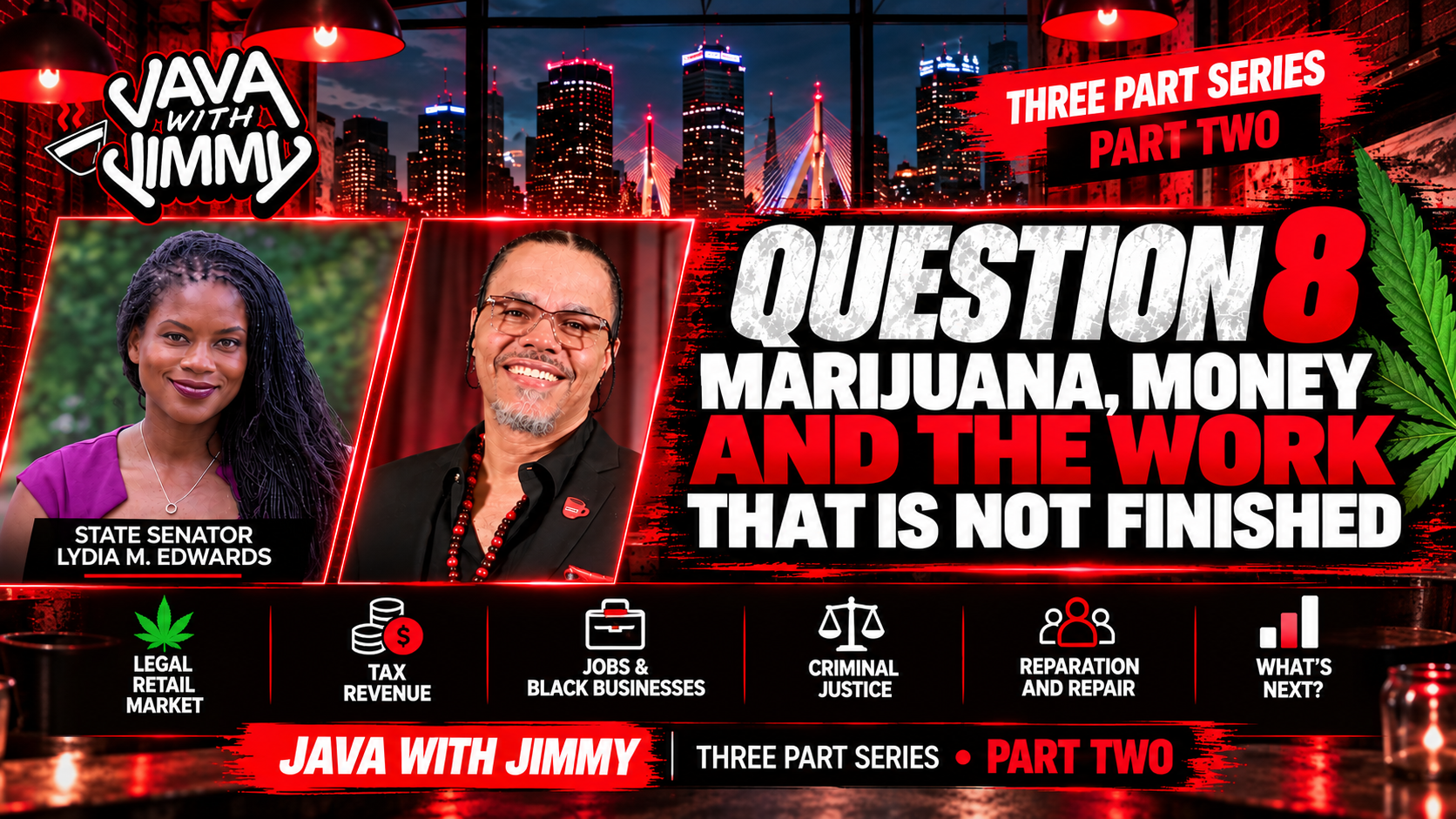
This is Part Two of a three-part Java With Jimmy series examining my conversation with State Senator Lydia Edwards. Part Three will look at Question 9, Massachusetts gun laws, ghost guns, public safety, and what Edwards says is at stake.
By James “Jimmy” Hills
WATCH THE ENTIRE CONVERSATION HERE
In Part One of this series, we looked at Question 3 and what changing our primary elections could mean for Black political power.
Now we move to Question 8, and this one can get confusing fast.
So let’s start with what your vote actually does.
What is Question 8?
Massachusetts legalized recreational marijuana in 2016. Today, adults can legally buy marijuana from licensed stores, and the state regulates and taxes those sales.
Question 8 asks voters whether Massachusetts should end that legal retail system.
A Yes vote would repeal the laws that allow, regulate, and tax recreational marijuana stores. Adults could still possess limited amounts, but the current retail market would end. A No vote would leave the current system in place.
During my conversation with State Senator Lydia Edwards, she made her position clear:
“We’re not going back.”
This is bigger than marijuana.
What stood out to me was where Edwards took the conversation.
She talked about money, jobs, Black businesses, and criminal justice.
Marijuana sales bring millions in tax revenue to Massachusetts and local communities. But Edwards said we should look beyond the tax dollars.
“It’s revenue in terms of jobs created, it’s revenue in terms of people of color and wealth as well.”
That matters.
For years, Black communities paid a heavy price for marijuana enforcement. People were arrested. People went to jail. Families lost income. People came home with records that made it harder to get jobs, housing, and other opportunities.
Then marijuana became legal.
Now there is money being made from something that once helped send people to jail.
We cannot leave that history out.
Then Edwards used another word: repair.
This is where our conversation went deeper.
Edwards talked about people who were formerly incarcerated and later got a chance to enter the legal cannabis business. She connected that work to criminal justice reform and the damage caused by the War on Drugs.
Then she said something that stopped me:
“It is generational trauma.”
She believes a legal and regulated cannabis market can be part of repairing some of that harm.
And yes, she used the word reparation.
That immediately made me think about Black economic development.
I know Black women moving in the cannabis space. I know people trying to build businesses and wealth in an industry where people who look like us once faced punishment for doing some of the same things that now make other people money.
So this is bigger than whether you personally smoke marijuana.
It is about who was harmed, who is benefiting now, and whether the work of repair is finished.
The current system is not perfect.
Edwards did not pretend that it is.
She believes Massachusetts should keep looking at how cannabis is regulated and where changes are needed.
That is important.
Keeping the current system does not mean saying everything is working. We can still ask whether Black businesses are getting a fair shot. We can look at safety, ownership, taxes and whether the people hurt most by the old drug laws are benefiting from the new system.
Edwards put it simply:
“We are absolutely not there.”
And I think that is the bigger conversation.
Question 8 is about marijuana, but it is also about jobs, money, criminal justice, Black economic development, and what repair looks like after generations of harm.
We should understand all of that before deciding what comes next.
Because if the harm is not finished, is the work of repairing it finished?
This is Part Two of a three-part Java With Jimmy series examining my conversation with State Senator Lydia Edwards. Part Three will look at Question 9, Massachusetts gun laws, ghost guns, public safety, and what Edwards says is at stake.