
QUESTION 3: Are We Opening the Primary or Watering Down the Black Vote?
By James “Jimmy” Hills
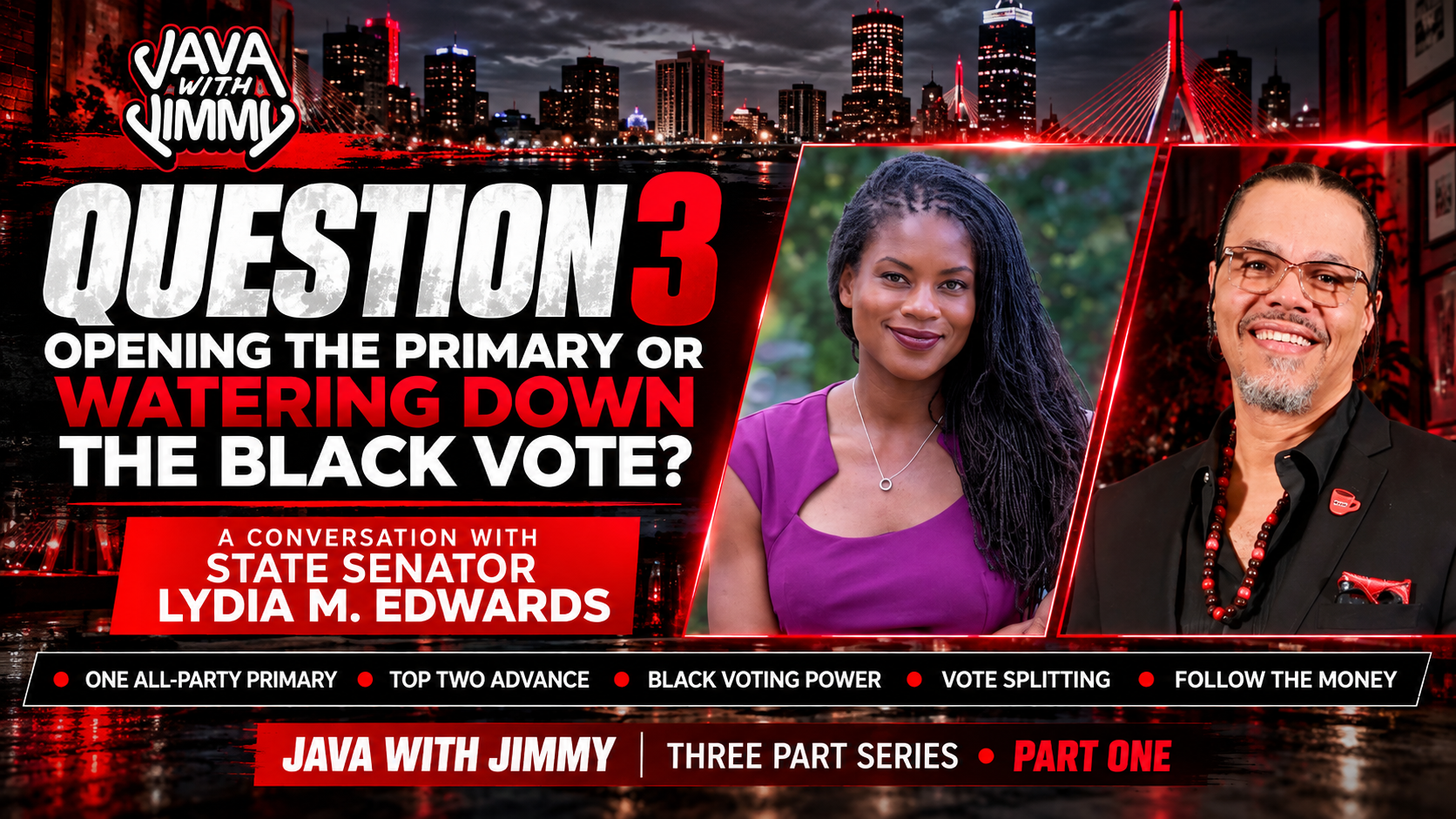
There are nine questions on the Massachusetts ballot this year, but Question 3 may be one of the most important ones we are not talking enough about.
I started paying closer attention when I saw Yes on 3 signs around Roxbury, Dorchester, and Mattapan. I wanted to know what this could mean for Black voters and Black candidates.
So State Senator Lydia Edwards joined me on Java With Jimmy, and she came with a warning:
“It’s a Trojan horse.”
Edwards believes Question 3 may sound like reform, but could weaken the political power Black voters already have.
So, what is Question 3?
Right now, Massachusetts has separate party primaries. Democrats vote in a Democratic primary. Republicans vote in a Republican primary. Unenrolled voters can choose either one.
Question 3 would change that.
If it passes, everyone would vote on one primary ballot. Democrats, Republicans and unenrolled voters would see the same candidates. The top two candidates, no matter their party, would move on to November. That means two Democrats or two Republicans could face each other in the final election.
I get why some people like the idea. More people are moving away from political parties. Some voters want to see everybody running and simply pick who they think is best. Supporters also say it could bring more competition.
But there is another side we need to look at.
What happens to the Black vote?
Black voters remain one of the strongest Democratic voting groups in America. Pew found that 83% of Black registered voters identify as Democrats or lean Democratic, compared with 12% who identify as Republican or lean Republican. That Democratic number was 88% in 2020, so there has been some movement.
We saw movement at the polls too. Trump received 15% of the Black vote nationally in 2024, up from 8% in 2020 and 6% in 2016. Black voters still voted strongly Democratic, with 83% voting for Kamala Harris.
Massachusetts has seen Republican votes grow too. Trump received 1,251,303 votes here in 2024, or 36% of the vote. Harris still won Massachusetts with 61.2%, so yes, Massachusetts remains a strongly Democratic state.
But those Republican voters are here. Under Question 3, we would all be voting in the same primary.
That's where my concern starts.
If the whole primary gets bigger faster than the Black vote grows, more Black people could vote while our share of the total vote gets smaller.
That is not voter suppression. More Black people voting is a good thing. But more voters and more political power are not always the same thing.
Edwards says Boston has already shown us the risk.
Edwards pointed to Boston mayoral elections, where the top two candidates move forward.
In 2013, several candidates of color ran for mayor, including Charlotte Golar Richie, John Barros and Felix Arroyo. John Connolly and Marty Walsh advanced.
Then look at 2021. Kim Janey, Andrea Campbell and John Barros were all Black candidates. Michelle Wu and Annissa Essaibi George advanced.
Edwards worries that when several Black candidates run in a top two system, they can split voters among themselves.
“We turn out when we see each other.”
Then she took it a step further:
“If we turn out when we see each other… and there are more of us on the ballot and we're in a top two system, we cancel each other out.”
Those Boston elections do not prove the same thing would happen statewide. Money, turnout, neighborhoods, endorsements, and the candidates themselves all matter.
But the examples raise a real question about splitting the vote when only two people can move forward.
Then Edwards followed the money.
Edwards also questioned who is paying for the Question 3 campaign. Her bigger question was why so much money is being spent to change how Massachusetts elections work.
She put it this way:
“They may have put signs in Mattapan. They put signs in Dorchester and Roxbury. It ain't coming from Mattapan, Dorchester and Roxbury.”
Edwards argues that if millions can be raised to improve democracy, some of that money could go toward finding and supporting candidates from communities that do not have enough representation.
Her message was clear:
“Go find the next Obama. Go invest in the young men and women who have great ideas and great potential.”
That hit me.
Maybe we don't just need to change how people vote. Maybe we need to invest more in who gets the chance to run.
But there is another side.
Question 3 supporters point to real problems with the current system.
Too many races have little competition. Incumbents can be hard to challenge. Many voters do not feel connected to either party. And in heavily Democratic areas, the real election can happen during a low-turnout primary instead of November.
Edwards agrees some of those problems are real. She disagrees with the fix.
“We agree on the problems, but we do not agree that this is the solution.”
That may be the most important line from our conversation.
We can agree the system needs work and still ask if this is the right way to fix it.
For me, the question is simple:
Will Question 3 bring more Black voters into the process and give us more power, or will the larger voting pool grow faster and water down the political power we already have?
I believe in more people voting. I believe candidates should earn the Black vote. And no political party should ever think it owns us.
But before we change the rules, I want us to look at our history, our turnout, our representation and who holds the power.
Question 3 may open the primary.
Who gains power when that door opens?
This is Part One of a three-part Java With Jimmy series examining my conversation with State Senator Lydia Edwards. Part Two will look at Question 8, cannabis, Black economic development, and what Edwards called the unfinished work of repairing the harm caused by the War on Drugs.