
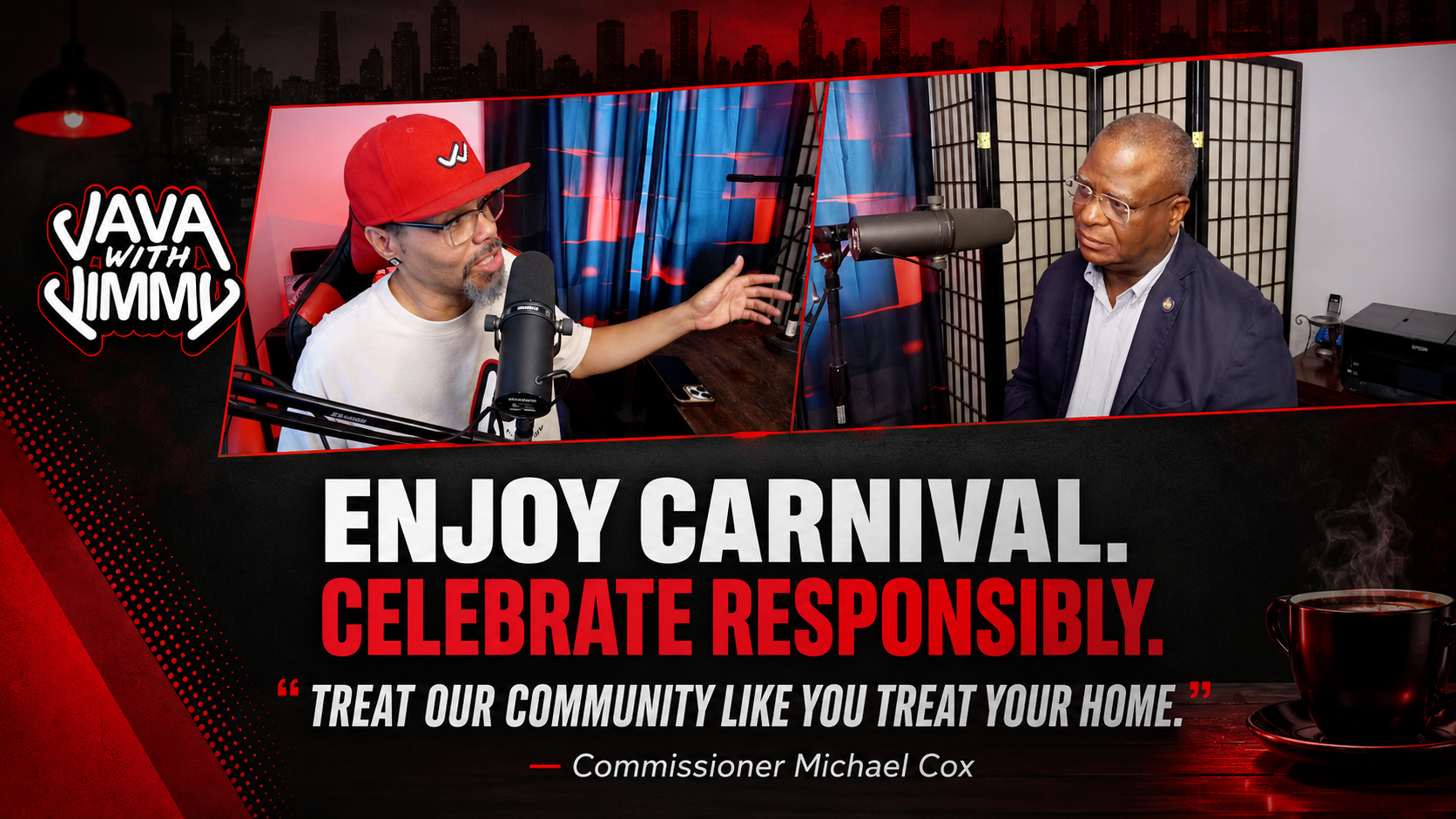
By James “Jimmy” Hills
(8-minute read)
There is a difference between being safe according to the numbers and actually feeling safe when you walk out your front door.
That was one of the most important takeaways from my conversation with Boston Police Commissioner Michael Cox.
Let me be clear about something from the beginning: Commissioner Cox did not sit with me and declare Boston “the safest city in America.” In fact, when I used that language in framing my question, he corrected it. What he did say is that when Boston is compared with other major American cities, the city is doing exceptionally well statistically — and that in his lifetime, the numbers show a level of public safety significantly better than previous eras.
But numbers do not tell the entire story.
And Cox acknowledged that.
“We’re supposed to deal with not only crime, but fear of crime,” he told me.
That distinction matters.
Crime statistics can tell us how many homicides, robberies, aggravated assaults, auto thefts, and other serious crimes are happening. They allow us to compare one year with another and Boston with other cities.
But statistics cannot completely measure what happens when violence hits your block, your family, your friend or your neighborhood.
Cox put it plainly: if only one serious incident happens on your street all year, statistically that may look like very little crime. But if you or your family experienced that incident, “that was a big deal.” There is trauma attached to it. There is memory attached to it. And there can be fear attached to it long after the police tape comes down.
That is where this conversation needs balance.
We should not dismiss good numbers. If homicides and other serious crimes are declining, that matters. Lives are behind those numbers too.
At the same time, we cannot throw statistics at communities and tell people they should feel safe because a spreadsheet says they are.
Both things can be true.
Boston can be performing better than many cities when it comes to crime, while residents living closest to violence can still experience their city very differently.
Cox brings another perspective to that conversation that not every police commissioner can bring.
Before he was Commissioner Cox, before the promotions, titles and command staff … he was a Black police officer working the streets of Boston.
And while working in plain clothes trying to apprehend someone connected to a homicide, Cox himself was mistaken for a suspect and beaten by fellow officers.
He described it during our conversation as understanding firsthand “what it’s like when unconstitutional policing happens when you’re a person of color and only because you’re a person of color.”
He was not committing a crime.
He was a police officer doing his job.
Cox said officers responding to the scene could not differentiate between him and the people they believed they were pursuing. That experience, and everything that followed it, helped shape both the man and the law-enforcement leader he became.
I thought that was important for our community to hear directly from him.
Because when we talk about young Black and Brown men being stopped, misidentified, or treated differently, Cox is not approaching that conversation only from theory, training manuals, or administrative policy.
He has lived a version of it.
And his takeaway from that experience is not simply that something bad happened to him.
His takeaway is that police departments have to be intentional about preventing those things from happening.
Officers have to be trained. They have to understand the communities they police. They need cultural awareness. They need relationships with the people who live there. They cannot automatically interpret clothing, behavior, race or culture as criminality.
For Cox, that comes back to community policing, not simply police officers being assigned to a community, but actually becoming familiar with and understanding that community.
That also explains why he believes diversity inside the Boston Police Department matters.
A department responsible for serving an increasingly diverse Boston should reflect the people who live here. Residents should be able to encounter officers who understand their neighborhoods, languages, cultures and experiences.
That does not solve every problem with policing.
But representation, familiarity and relationships can make a difference.
The larger conversation about public safety, however, cannot stop with police.
Cox repeatedly described safety as something that requires partnership, law enforcement, residents, city agencies, and community organizations all having a role.
And he made another point worth sitting with.
There is a difference between acknowledging legitimate community fear and deliberately feeding fear.
Cox pushed back against people taking isolated incidents and automatically presenting them as evidence of a larger trend when the data does not support that conclusion. He said when police identify an actual pattern or threat, they have a responsibility to tell the public.
That same responsibility should apply when there is not a pattern.
I agree.
Because sensationalizing violence for attention, politics, clicks, or votes does not make anybody safer.
But neither does dismissing community concerns because overall crime statistics happen to look good.
The responsibility is to tell the truth about both.
The numbers matter.
The lived experience matters.
The person who has never personally encountered violence may experience this version of Boston as extraordinarily safe. Somebody living on a street where there was a shooting last week may hear those same statistics and say, that is not the Boston I am experiencing.
Neither conversation should automatically cancel the other.
In fact, the work of public safety is figuring out how we get those two realities closer together.
Because ultimately, the goal cannot simply be producing statistics that say Boston is safer.
The goal has to be creating a Boston where more people — in every neighborhood — can actually feel it.
And Then There Is Carnival
Part of why we wanted this conversation before Carnival was because every year we seem to have the same debate.
Something happens somewhere in the community during Carnival weekend and suddenly Carnival gets blamed for everything.
Cox made an important distinction.
He described Carnival as a “wonderful cultural event” and said the parade itself has not been the primary challenge.
According to Cox, some of the violence people associate with Carnival has instead happened around house parties, illegal after-parties, excessive drinking, and gatherings taking place throughout surrounding neighborhoods.
His comparison was simple: if people hold parties across the city during the Super Bowl and something happens at one of those parties, we do not automatically blame the Super Bowl.
The same distinction should be made with Carnival.
That does not mean there are no public safety concerns.
Anytime thousands of people gather, add alcohol, disagreements or other activity, police have to prepare for the possibility that something can happen.
But that is different from saying the cultural celebration itself is responsible for the violence.
And I thought that distinction was important.
Because Carnival is more than a parade.
It is culture, it is community, it is Caribbean people celebrating who they are.
And we should not allow violence that happens somewhere during the weekend to automatically define the entire celebration.
Cox’s message for people attending was pretty straightforward: enjoy yourself, celebrate responsibly and respect the community.
No guns.
No weapons.
No public drinking.
And while marijuana may be legal, he reminded people that public consumption is not.
His words were probably the simplest way to put it:
“Treat our community like you treat your home.”
That message applies not just to Carnival but to anybody coming into one of Boston’s neighborhoods for a large public event.
What Happens After the Parade Matters Too
I also pushed Cox on something I have heard from people in the community.
After other cultural celebrations in Boston, people have watched large post-event gatherings continue, sometimes with loud music and other quality-of-life concerns, and questioned whether enforcement looks the same from one community or event to another.
Cox said the expectations are supposed to be the same.
He acknowledged hearing concerns about some of those post-event gatherings and quality-of-life issues and said police sometimes have to prioritize activity during extremely large events and long days.
But he also made a larger point.
The future of these cultural events depends in part on people attending them responsibly.
That means celebrating without giving anybody an excuse to say the event itself is the problem.
And Cox noted that Boston police make similar announcements around other large events, including the South Boston St. Patrick’s Day parade, where residents have raised concerns for years about drinking, public urination, and disruptive behavior.
That consistency matters too.
Because accountability cannot change depending on what neighborhood the celebration is in or what culture is doing the celebrating.