
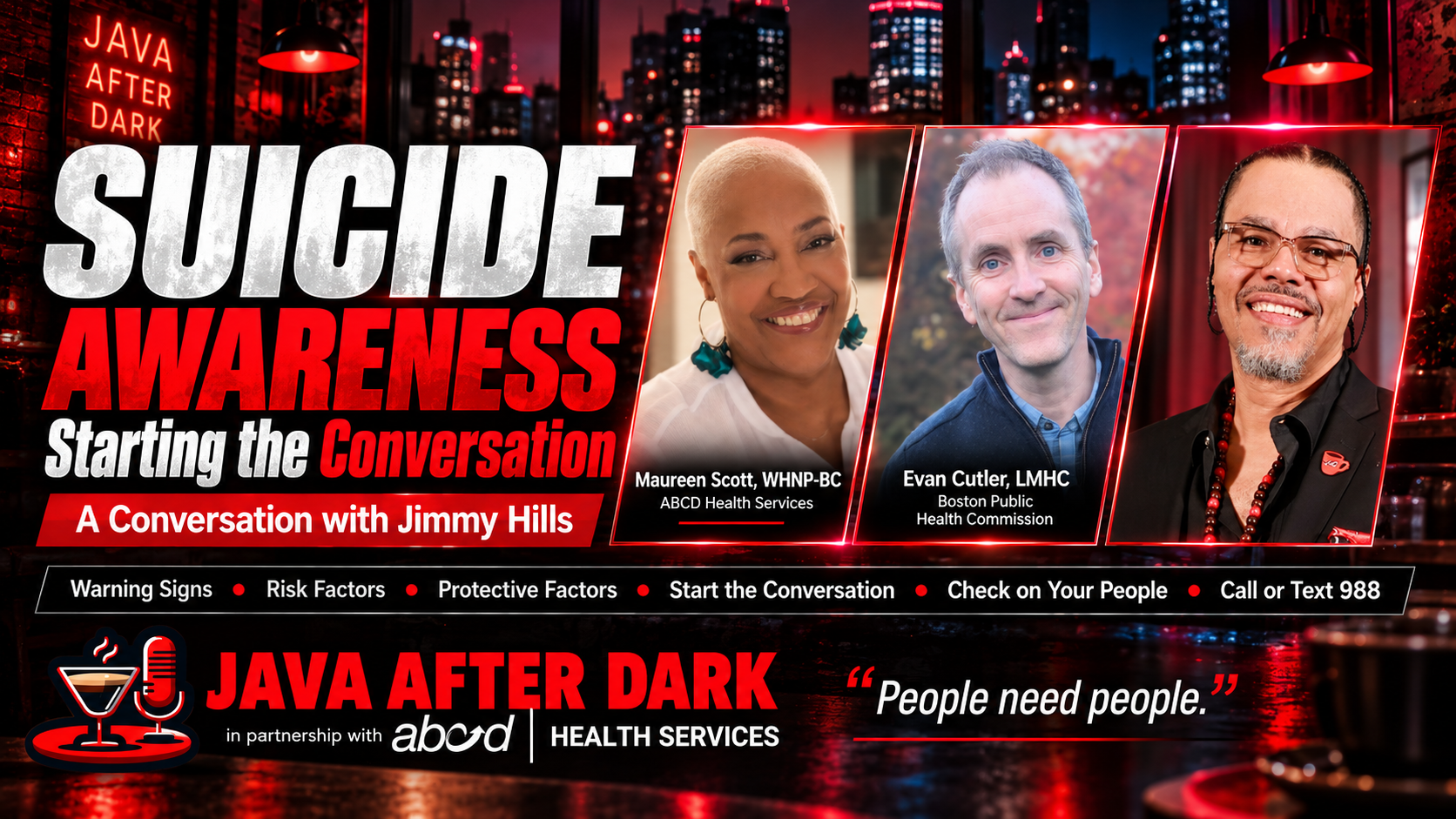
SUICIDE AWARENESS … STARTING THE CONVERSATION
By James “Jimmy” Hills
WATCH THE ENTIRE CONVERSATION HERE!
Suicide is hard to talk about. But not talking about it does not make it go away.
On Java After Dark, we sat down with ABCD Health Services Director Maureen Scott and mental health therapist Evan Cutler to talk about suicide awareness, the warning signs, and how all of us can help.
One thing was clear: suicide is not just a personal issue. It is a community issue. People need people.
Someone may be hurting and never say, “I need help.” They may pull away from family and friends. Their mood may change. They may stop doing things they once loved. They may talk about feeling hopeless, trapped, alone, or like other people would be better without them.
That is why awareness matters.
We also talked about something very important. Asking someone if they are thinking about suicide does not put the idea in their head. Sometimes asking the question may open a door that person was afraid to open.
Listen. Do not judge. Do not try to fix everything right away. Let the person know they are seen, heard, loved, and valued.
And pay attention to change.
If somebody who is always around suddenly disappears, check on them. If their social media posts suddenly become darker, check on them. If an elder becomes more isolated, check on them. If a young person does not seem like themselves, check on them.
Sometimes a simple, “How are you really doing?” can matter more than we know.
We also have to make it easier for people to ask for help. Shame, fear, bad past experiences with health care, and the idea that asking for help is weak can stop people from speaking up.
But asking for help is part of staying alive.
What is 988?
The 988 Suicide & Crisis Lifeline is available 24 hours a day, seven days a week. It is free and confidential. You can call 988, text 988, or chat online through 988Lifeline.org.
And this is important: you do not have to be thinking about suicide to use 988.
You can reach out if you are depressed, having a hard time, feeling overwhelmed, or simply need somebody to talk to. You can also contact 988 because you are worried about someone else.
Here is how it works:
Call 988: You will be connected with a trained counselor. They will first ask if you are safe. Then they will listen, talk with you about what is happening, and help connect you with support or resources.
Text 988: Send any message to 988. You will answer a few short questions and then connect with a counselor by text.
Chat: You can also visit 988Lifeline.org and use the chat option if talking on the phone does not feel comfortable.
Spanish: Call 988 and press 2 for a Spanish speaking counselor. Spanish text and chat services are also available.
Veterans, service members and their loved ones: Call 988 and press 1 to reach the Veterans Crisis Line.
You do not need to know exactly what to say.
You can start with, “I am having a hard day.” You can say, “I don't feel like myself.” You can say, “I am worried about my friend.” Or you can simply say, “I need somebody to talk to.”
The counselor's job is to listen without judgment and help you get through that moment.
There is also an important difference between 988 and 911.
988 is built around mental health and emotional crisis support. Most contacts are handled by counselors without emergency services. The Lifeline says emergency services may be contacted when someone is in immediate danger and a safer plan cannot be worked out. If someone is in immediate physical danger or needs emergency medical care, call 911.
We Have Help Right Here in Our Community
SCHOOL-BASED HEALTH CENTERS:
School-Based Health Centers
To find out if a BPS school has a School-Based Health Center (SBHC) they can visit, parents and students may visit the following website:
Community Behavioral Health Centers
For details, directions, and contact info for BMC's Community Behavioral Health Center, which any young person or adult can use for a same-day urgent visits for mental health or substance use concerns (walk-ins accepted, no waitlists, no insurance needed), visit the following website:
For audience members who live in Massachusetts, but outside Boston, visit the following Mass.gov website to locate their closest Community Behavioral Health Center:
https://www.mass.gov/find-a-cbhc
Dee Dee’s Cry
We also talked about a resource that has been part of this conversation on Java With Jimmy for years.
My friend Toy Burton is the founder and executive director of DeeDee's Cry, a Roxbury based organization created after the death of her sister, Denita “DeeDee” Morris. DeeDee's Cry works to bring suicide prevention, mental health education, and support after suicide loss directly into Black, Brown, and other communities of color.
DeeDee's Cry
2 John Eliot Square #2C
Roxbury, MA 02119
Phone: 617-410-8693
DeeDee's Cry also offers support groups. They include Life After Loss for people who have lost someone to suicide, Man2Man for BIPOC men, I'm Still Here for suicide attempt survivors, Living Life in Recovery, and Healing Begins With Me.
To ask about joining a support group, email deedeescry@gmail.com.
The biggest message from our conversation was simple.
Check on your people. Tell people you love them. Pay attention and ask the question. Then listen to the answer.
And if life gets too heavy, you do not have to carry all of it by yourself.
Call or text 988.
Sometimes people need help getting through the next day. Sometimes they need help getting through the next hour.
And sometimes they just need someone on the other end to listen.
Keep reminding people that their life has value.
That is what suicide awareness looks like in community.