
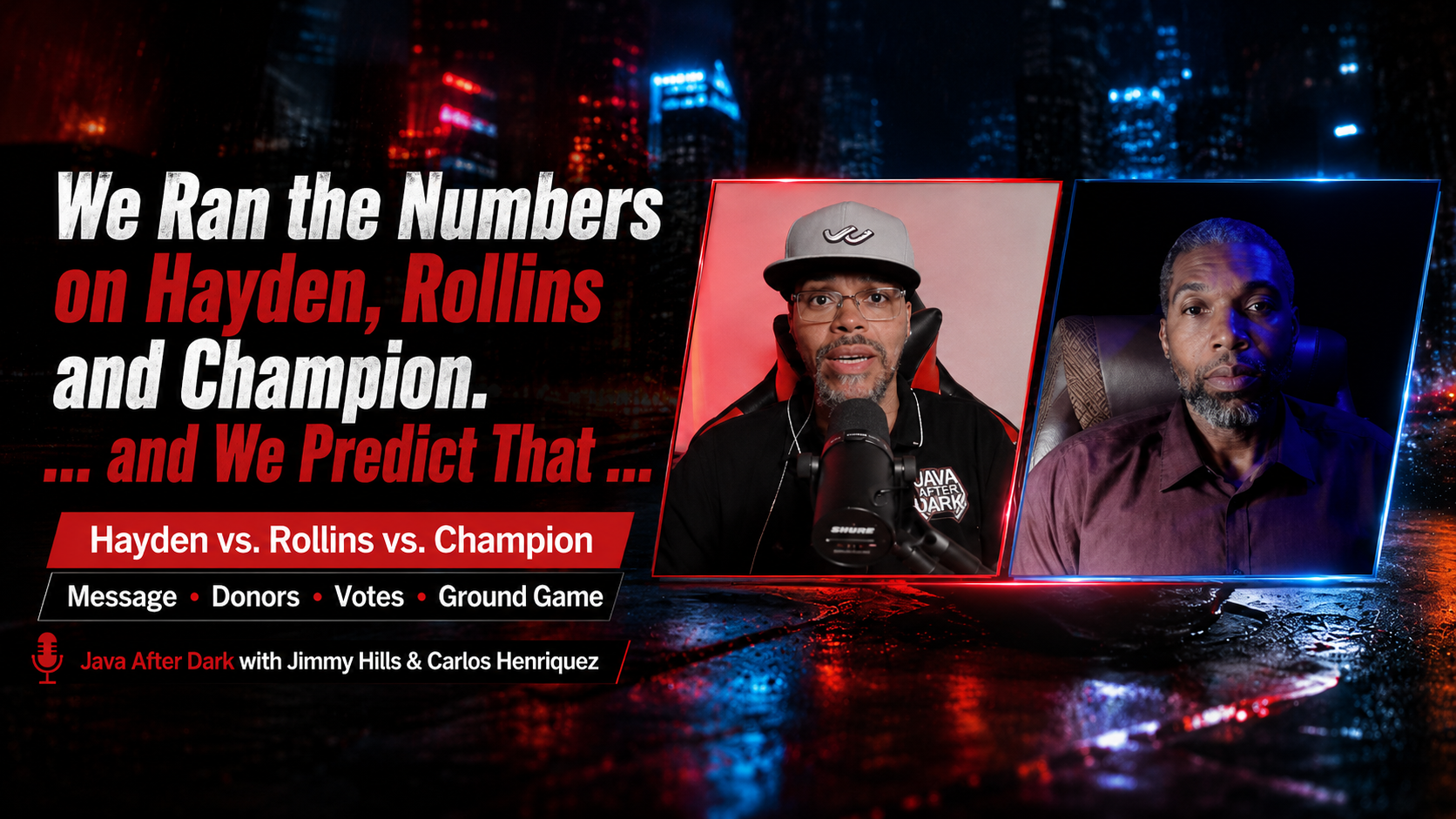
by James “Jimmy” Hills and Carlos Henriquez.
Election season brings plenty of noise: endorsements, social media posts, lawn signs, debates, and fundraising numbers. But during a recent Java After Dark conversation with political strategist and former State Representative Carlos Henriquez, we tried to strip some of that away and look at what actually matters.
How many people can you get to vote? And what does it take to get them there?
The September 1, 2026 Democratic primary for Suffolk County District Attorney features incumbent Kevin Hayden, former District Attorney Rachael Rollins, and former Assistant District Attorney Linda Champion. The date and all three candidates are confirmed by the Massachusetts Secretary of the Commonwealth. (sec.state.ma.us)
There is also something significant about this race that should not get lost in all the politics: all three candidates for Suffolk County District Attorney are Black, and two of them are women. During our conversation, I asked Carlos whether he could recall another Suffolk County DA race with three Black candidates. He could not. Whatever the outcome, that representation in a race for one of the most powerful positions in our criminal legal system is worth acknowledging.
The history gives us some numbers to work with.
Rollins won the five-way Democratic primary in 2018 with 35,124 votes. Hayden won the two-person primary in 2022 with roughly 41,500 votes, defeating Ricardo Arroyo by 6,060 votes. Champion, who was also in the 2018 race, received roughly 5,000 votes. According to the campaign analysis presented on Java After Dark, Rollins spent approximately $6.17 per vote in her 2018 campaign, while Hayden spent approximately $6.42 per vote in 2022.
Those numbers matter because money itself does not win an election. Money gives a campaign the ability to find, communicate with, and turn out voters.
As Henriquez explained, campaigns have expenses that most voters never see: voter data, staff, campaign offices, mail, signs, phone banks, technology, and the infrastructure needed to organize volunteers. His point was simple: even though casting a ballot is free, persuading and organizing enough people to cast those ballots costs money.
That is why the number of unique donors deserves attention alongside the total dollars raised.
In Rollins' successful 2018 campaign, the numbers reviewed on the show showed 1,649 unique donors, 1,838 contributions, and approximately $233,275 raised. That worked out to an average of roughly $141 per unique donor. That campaign ultimately produced 35,124 votes across Boston, Chelsea, Everett, and Winthrop.
The 2026 snapshot reviewed on the show looked very different: 62 unique donors and roughly $13,000 raised during the period examined. Henriquez called the difference significant because fewer financial resources can mean fewer staff, fewer mail pieces, less voter contact, and greater dependence on volunteers.
Hayden's donor numbers also changed. The figures reviewed during the conversation showed his unique donor count moving from 1,302 during his previous campaign to approximately 420 in the current period. Henriquez cautioned against automatically assigning one explanation to that decline, noting that fundraising changes can happen for several reasons.
Champion, meanwhile, showed movement in the opposite direction. The figures reviewed showed her moving from 284 unique donors in 2018 to approximately 343 in the current cycle, while raising roughly $25,000 more than during the comparable period of her earlier campaign.
But Henriquez made another distinction that matters: a donor is not automatically a voter.
A contribution from somebody living outside Suffolk County can help pay for mail, staff or a sign, but that donor cannot cast a ballot in the Suffolk County DA race. The campaign then has to convert that money into contact with somebody who can vote.
As Henriquez put it, “The job of your campaign is to convert energy into a vote.”
We saw the same issue in the First Suffolk State Senate race.
During the period reviewed — December 1, 2025 through August 17, 2026 — incumbent Senator Nick Collins had approximately $364,000 to $365,000 on hand and about 900 unique donors, while first-time candidate Latoya Gayle had approximately $73,000 and about 400 unique donors. Among the donor figures reviewed, Collins had 381 unique Boston donors and 510 from outside Boston, while Gayle had approximately 270 Boston donors.
That financial advantage gives Collins significantly greater capacity to communicate. It does not, by itself, guarantee him more votes.
And that may have been the most important point of the entire conversation.
“Fundraising isn’t everything. Many of our current elected officials were outspent but came out on top votes wise. Lawn signs and mailers don’t vote. Who is on doors, who is connecting on the ground, who has a vision vs a list of grievances? That’s what wins elections.” contributed to the conversation by Segun Idowu.
Money can buy voter contact, but a campaign without enough money has another currency: people. Volunteers can knock on doors a campaign cannot afford to mail. They can make phone calls, distribute literature, identify supporters, and make sure those supporters actually vote.
Henriquez described that as the ground game — and noted that candidates have won while being outspent because organization can counterbalance money.
For the DA race, Henriquez estimated that somewhere around 80,000 to 90,000 votes could be in play, making approximately 30,000 votes a reasonable working target in a three-way contest. That is analysis, not an official projection, but it puts the fundraising numbers into perspective: whichever campaign raises the most money still has to turn its resources into enough actual voters to reach that number.
And because we spent the night looking at the numbers, we also put our predictions on the record. Based on the data and campaign indicators we reviewed, the prediction was Hayden first, Rollins second, and Champion third in the Suffolk County DA race, with Collins defeating Gale in the First Suffolk State Senate race. Henriquez made it clear that this was not an endorsement or a statement about who he preferred. Hills echoed the same. It was a prediction based on the numbers. He also acknowledged that two potential “upsets” may be possible. Can Rollins gain more votes than Hayden? Can Champion gain more votes than Rollins?
You can have enthusiasm online. You can have the endorsements. You can have money. You can pack a debate. You can have people arguing for you every day on Facebook.
But on September 1, the question becomes much simpler, and ultimately, that is what elections expose.
How much of that energy became votes?
That is when we find out who actually built a voting coalition — and who simply looked like they had one.